
In the world of aircraft hangar doors, installation complexity is often mistaken for quality. Many rolling hangar door systems are designed with unnecessary complications—multiple hardware variations, difficult alignment requirements, and field-dependent adjustments that slow down installation and increase costs.
But when it comes to hangar door installation, complexity doesn’t equal performance.
At Well Bilt, our aircraft hangar door systems are engineered with a different mindset: simplify the installation process while delivering superior strength, reliability, and long-term performance.

Many industrial hangar doors and sliding hangar door systems introduce avoidable challenges during installation.
Contractors and installers often face:
These issues don’t just slow down the hangar door installation process—they increase the risk of misalignment, rework, and long-term performance problems.
Well Bilt rolling hangar doors are designed with real-world installation conditions in mind.
Our systems follow a structured, phase-based installation process—from pre-installation verification to final testing and commissioning—ensuring every step is efficient, repeatable, and predictable.
Instead of relying on field improvisation, our hangar door systems are engineered to reduce complexity and streamline execution.
Key advantages include:
The result is a faster, cleaner, and more efficient aircraft hangar door installation.
The completed repairs at Beta Technologies helped return the bifold hangar door system to smooth, reliable operation while supporting the demands of a modern aviation environment. Projects like this reinforce the importance of experienced hangar door service teams that understand the unique operational requirements of aviation facilities.
One of the biggest advantages of working with Well Bilt is that we design and manufacture our own operator systems in-house.
Our Zeus and Hercul-Eze systems are engineered specifically to work with our hangar door systems, giving us full control over quality, performance, and compatibility.
This allows us to:
Not all rolling door systems are created equal—especially when it comes to how the door is supported and moved.
Traditional systems often rely on basic caster-style wheels that are primarily designed to carry weight. While they may work under light conditions, they can struggle when multiple panels are in motion, leading to inconsistent contact with the ground and uneven operation.
The Zeus system was designed to solve that problem.
Unlike typical casters, Zeus is engineered to both support the weight of the door and actively assist in its movement. This creates a more controlled and reliable system, especially for large, multi-panel aircraft hangar doors.
Key advantages of Zeus include:
Because Zeus is integrated into the overall system design—not added as an afterthought—it plays a direct role in both installation efficiency and operational performance.
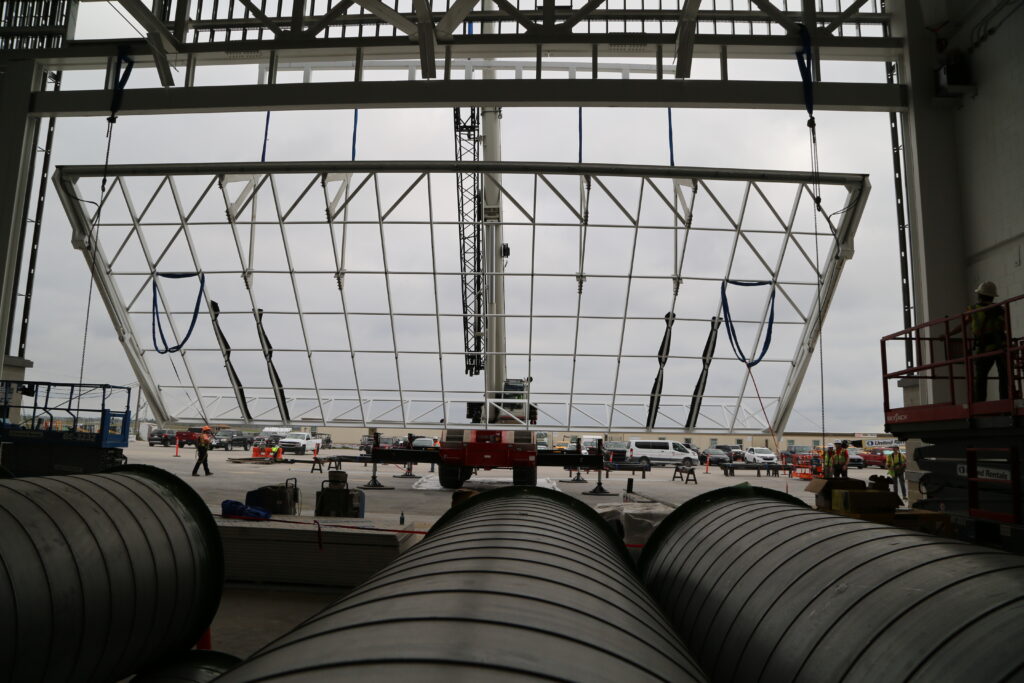
Every Well Bilt hangar door system is custom-engineered for its specific application—but that doesn’t mean installation should be complicated.
Our installation approach emphasizes:
As outlined in our installation standards, each phase must be completed and verified before moving forward—ensuring consistent results across every project.
Simplifying hangar door installation doesn’t mean sacrificing quality—it means eliminating unnecessary failure points.
Well Bilt aircraft hangar doors are designed to deliver:
For contractors, airport facilities, and military installations, the efficiency of a hangar door installation directly impacts project timelines and costs.
A simpler system provides:
When it comes to aircraft hangar door systems, the best designs aren’t the most complicated—they’re the most effective.
Well-Bilt doors are engineered to simplify installation while delivering high-performance results in the field.
Because at the end of the day, a hangar door system should do two things:
Install efficiently.
Operate reliably.
And that’s exactly what Well Bilt delivers.